
The Modern Victory Garden
Locked
FREE PDF

Heirloom seed is packed in harvest batches. Another batch becomes available after the next harvest is germination-tested and packed.
From 1943 Victory Garden lineage
16,000+ seeds across 35 varieties
Open-pollinated non-hybrid non-GMO
Plant like your grandmother fewer grocery runs
One-time purchase · No subscription
Locked
FREE PDF

Locked
FREE PDF

Locked
FREE PDF
Digital downloads only — no physical books included. Your PDF guides will be delivered digitally after purchase. No additional shipping required for these gifts.

Each kit contains 35 labelled packets with more than 16,000 seeds across vegetables, greens and herbs. Explore the complete variety list below.
Heirloom, open-pollinated, non-hybrid and non-GMO varieties. Keep the packet labels and follow the sowing instructions for each crop.
Choose crops for your climate and season, sow at the recommended depth, and provide suitable light, water and soil. Harvest food and save mature seed where appropriate.
Fast crops such as radishes may be ready in about a month. Tomatoes and winter squash need longer. Timing varies with variety, planting conditions and weather.
Keep unused seed sealed, cool, dry and away from light. Viability differs by crop and storage conditions; try a small germination test before sowing older packets.

THE COMPLETE COLLECTION
From quick salad crops to hearty winter squash, every kit brings a broad selection of familiar garden favourites. Each packet is labelled so you can plan your planting.
 1
 2
3
 4
 5
 6
 7
 8
 9
 10
 11
 12
 13
 14
 15
 16
 17
18
19
 20
 21
 22
 23
 24
 25
 26
27
 28
 29
 30
31
 32
 33
 34
 35
↓ Scroll the list to explore all 35 varieties
Varieties and growing times depend on the supplied packet and local conditions. Save this list as a starting point for your garden plan.
FIND YOUR GROWING SEASON
The vault includes cool-season and warm-season crops. Choose what suits your local season, then use your frost dates and the seed packet to decide when to sow.
Fairbanks z2 Minneapolis z4 Kansas City z6 Atlanta z8 Miami z10 Honolulu z12
Start tender crops indoors and make the most of cool-season greens, roots and peas.
Enjoy a broad mix of spring, summer and autumn crops with season-by-season sowing.
Use mild winters for greens and roots; plan heat-loving crops around summer conditions.
Match sowing to local rainfall, heat and day length, with shade where appropriate.
USDA zones describe winter minimum temperatures. For annual vegetables, frost dates, heat and your local growing season are especially useful.
FROM SEED TO TABLE
Start with a fast crop for an early reward, then let slower varieties fill your garden through the season.
Illustrative harvest windows. Some are measured from transplanting rather than sowing; check your packet. Actual timing varies.
BEFORE YOU BUY SEED
A useful seed collection is more than a long list of names. Look for clear varieties, enough seed to get started, and the option to grow again.

Named varieties help you choose crops and follow the right growing instructions.
Open-pollinated crops can reproduce true to type when correctly isolated and saved.
A mix of herbs, greens, roots and fruiting vegetables gives you options through the season.
Sealed, cool and dry storage helps preserve seed for a later planting.
A COLLECTION YOU CAN KEEP GROWING
Hybrids can make excellent crops, but saved seed may not resemble the parent. Open-pollinated heirlooms make it easier to maintain a variety through careful seed saving.

Seed saving requires healthy plants, suitable isolation and fully mature seed. Cross-pollination and storage conditions can change results.
WHAT IT ACTUALLY COSTS
Seed is a small purchase you make forever. Forty to a hundred and twenty dollars a year, every year, for as long as you keep a garden — because hybrid seed can't be saved and replanted.
Open-pollinated seed is a one-time purchase with a maintenance cost of zero. You pay once and harvest your own resupply every autumn.
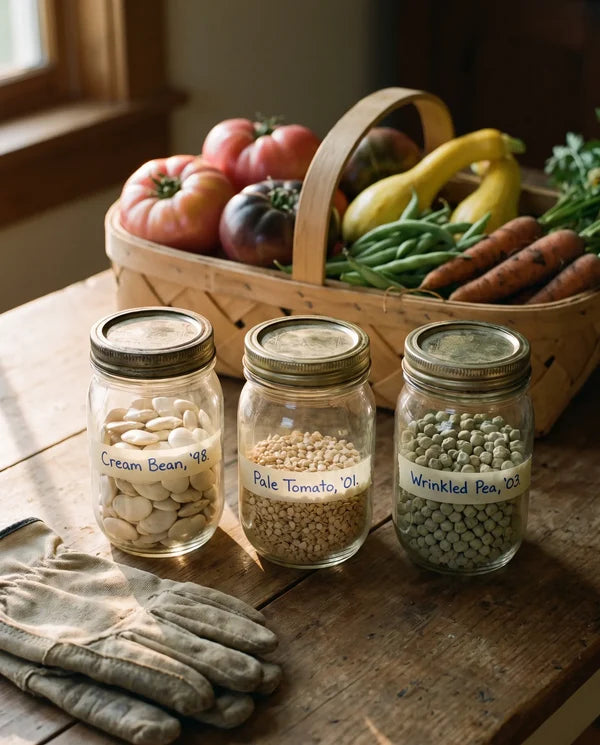
Illustration assumes $40–$120 spent on replacement seed each year versus a single $49.99 kit followed by successful seed saving. Soil, tools, water and other growing costs are additional. Savings are not guaranteed.
WHY OPEN-POLLINATED SEED MATTERS
Home gardens have helped households make the most of limited space and uncertain times. The practical skills of sowing, harvesting and saving seed still have a place today.

Farm workers enlisted and European farmland became battlefields. School children, housewives and ordinary citizens were urged to reclaim public parks, school yards and private lots and plant them. By the end of that war the effort had a name: victory gardens.
The USDA put the 1943 figure at 42% of all produce. Seed went out with a booklet that taught planting, harvesting and — the part that mattered — how to save seed so nothing had to be mailed the following year.
Both programmes used open-pollinated seed, and both shipped a guide alongside it. Hand a family seed once and teach them to keep it, and that family is set for years on a single distribution.
That is exactly what this kit is.
Sources: “Sowing the Seeds of Victory,” Architect of the Capitol (aoc.gov) for the 1917–18 figures and the National War Garden Commission. The National WWII Museum, New Orleans, and the National Park Service for the WWII figures. The 42% figure is USDA data.
POST-PURCHASE SURVEY
Seeds germinated within the first two weeks of planting
Harvested vegetables and herbs in their first season
Found it easy with no prior gardening experience
Satisfied with quality and would recommend it
Self-reported by Garden's Pulse customers in a post-purchase survey. Not a controlled trial. Germination, harvest timing and yield vary with climate, soil, water and care — nothing here is a guarantee of any specific outcome.


A broad selection makes it easier to plan a first vegetable patch, with familiar crops and labelled packets ready to organise.

Michael K.
Garden’s Pulse product feedback
From quick greens to slower summer crops, this collection offers a way to try different plants and build a growing routine.

Jessie L.
Garden’s Pulse product feedback
Open-pollinated varieties make seed saving part of the experience, helping a single season become a longer gardening habit.

Daniel H.
Garden’s Pulse product feedback
ROOM TO TRY IT FOR YOURSELF
Try the collection and contact our team within 90 days if it does not meet your expectations. We will help with growing questions and the product guarantee.
Follow the packet instructions and provide suitable growing conditions.
Save your order number and a note of the varieties you planted.
Contact us within 90 days for help with this product’s guarantee.
BEFORE YOU DECIDE
One kit brings together 35 labelled heirloom varieties. It is a convenient starting collection rather than a substitute for choosing crops suited to your garden.
Choose varieties for your climate, frost dates and available light. Cool-season and warm-season crops need different sowing windows. Local growing advice can help.
Start with a few easy crops, such as radishes, beans or lettuce. Follow the packet instructions and expand as you learn.
Keep packets sealed in a cool, dry and dark place. Germination life varies by crop and storage conditions.
Choose healthy plants, allow seed to mature fully, dry it thoroughly, then label and store it. Some crops need isolation to prevent cross-pollination.
A larger bundle can be shared with family, used for separate gardens or kept as additional seed stock. Choose the quantity that fits your plans.
The crossed-out amount is the listed comparison price for the number of kits included. The selected bundle price is a one-time payment; it does not start a subscription.
Check temperature, moisture, sowing depth and time allowed for that crop. Keep your order number and contact our support team for help with the 90-day product guarantee.